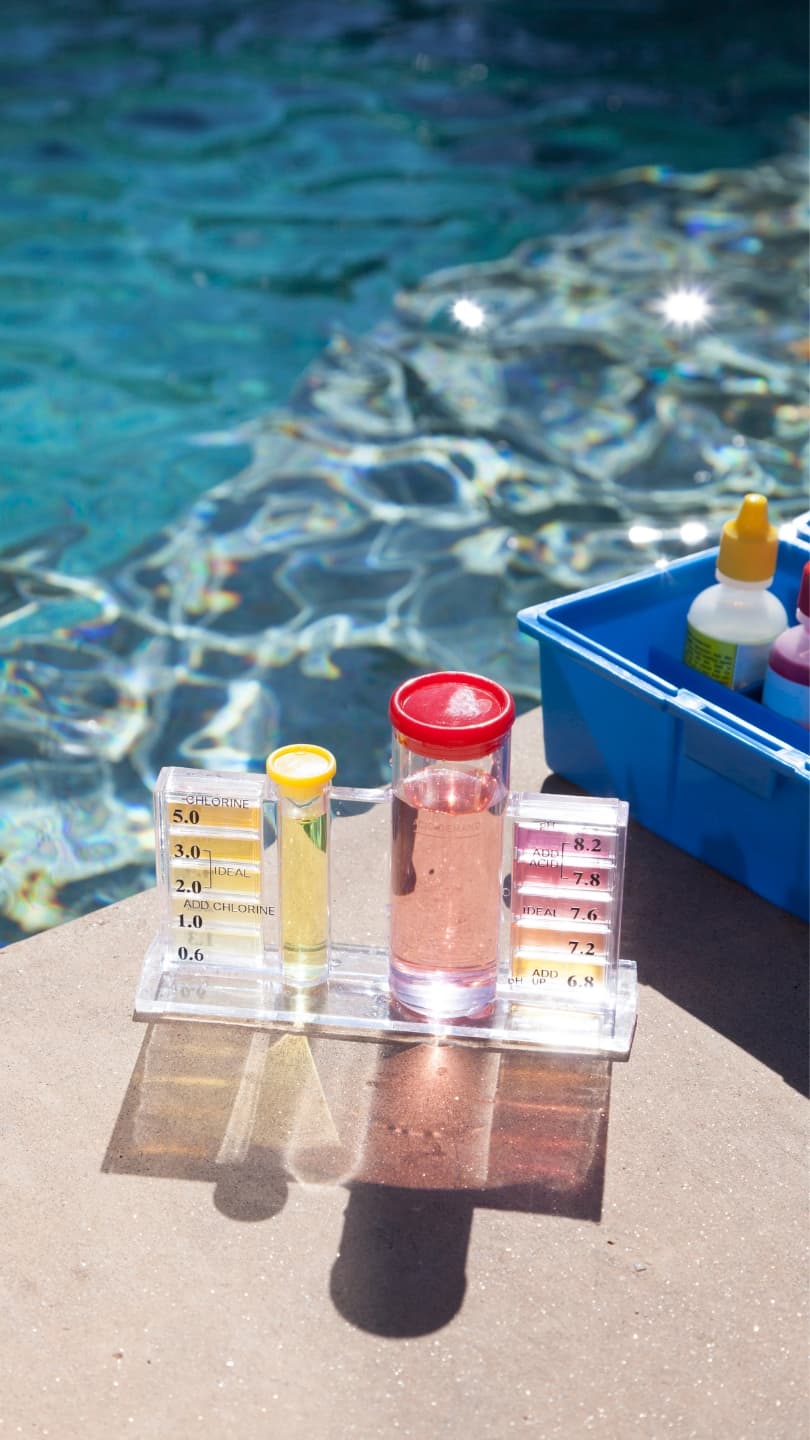
If you have ever looked at a strip, drop-test kit, or store printout and wondered which number matters first, you are not alone. The confusing part is not the name of each reading. It is understanding how one change can move several others.
Chlorine may disappear because sunlight and contaminants are using it. pH may keep climbing because the buffering capacity is high. A sanitizer reading may look acceptable while too much stabilizer is making that amount less useful. Clear water can even hide a developing imbalance. Every pool develops its own pattern. You will learn how to read those clues without treating every number as a separate problem.
The answer is not to chase every number separately. Before treating a pool, start with a complete reading, understand the relationships, and make one measured decision at a time.
How Pool Water Chemistry Works as One System
Pool chemistry works in three connected jobs:
- 1
Sanitation:
Chlorine controls germs and organic contamination.
- 2
Stability:
The buffering system keeps the acidic/basic reading from swinging too quickly.
- 3
Water balance:
Mineral content, temperature, acidity, and other factors affect scaling or corrosive behavior.
Circulation and filtration support all three. A perfect-looking chemical result cannot compensate for a pump that is not moving enough water or a filter that is packed with debris. In the same way, good flow cannot sanitize water when the active sanitizer is too low.
Weather and use matter too. Sunlight consumes chlorine. Rain and fresh fill water can dilute readings. Pollen, leaves, sweat, dirt, and a busy weekend increase sanitizer demand. In the Charlotte area, hot sunny stretches followed by summer storms can change a pool faster than a homeowner expects.
Think of the report as a dashboard rather than a pass-fail sheet. One unusual number may be the cause, the effect, or a clue that another part of the system needs attention.
Pool Chemistry Target Levels at a Glance
These are common reference ranges for an outdoor residential pool, not universal dosing instructions. The right operating target can change with the sanitizer, surface, temperature, equipment manufacturer, and stabilizer relationship. Always follow the label and the instructions for the installed system.
| Reading | Useful starting reference | What it tells you |
|---|---|---|
| pH | Often 7.2–7.8; CDC recommends 7.0–7.8 | How acidic or basic the water is and how the environment affects comfort, chlorine performance, surfaces, and equipment |
| Free sanitizer | CDC minimum: 1 ppm without stabilizer; 2 ppm when stabilized chlorine is used | How much active sanitizing reserve is available |
| Total alkalinity | Common manufacturer range: 80–120 ppm | How strongly the water resists a rapid chemistry change |
| CYA / stabilizer | Common outdoor starting range: 30–50 ppm | How much protection chlorine has from sunlight and how much sanitizer the pool needs |
| Calcium hardness | Common broad range: 150–400 ppm; surface-specific | Whether mineral content is contributing to aggressive or scale-forming conditions |
| Salt | Follow the generator manufacturer | Whether a chlorine generator has the concentration it was built to use |
pH
- Useful starting reference
- Often 7.2–7.8; CDC recommends 7.0–7.8
- What it tells you
- How acidic or basic the water is and how the environment affects comfort, chlorine performance, surfaces, and equipment
Free sanitizer
- Useful starting reference
- CDC minimum: 1 ppm without stabilizer; 2 ppm when stabilized chlorine is used
- What it tells you
- How much active sanitizing reserve is available
Total alkalinity
- Useful starting reference
- Common manufacturer range: 80–120 ppm
- What it tells you
- How strongly the water resists a rapid chemistry change
CYA / stabilizer
- Useful starting reference
- Common outdoor starting range: 30–50 ppm
- What it tells you
- How much protection chlorine has from sunlight and how much sanitizer the pool needs
Calcium hardness
- Useful starting reference
- Common broad range: 150–400 ppm; surface-specific
- What it tells you
- Whether mineral content is contributing to aggressive or scale-forming conditions
Salt
- Useful starting reference
- Follow the generator manufacturer
- What it tells you
- Whether a chlorine generator has the concentration it was built to use
The chart gives you context, not a shopping list. Before you adjust or raise any level, confirm the result and check the product directions. Two pools with the same acidity reading can need different treatment because their surfaces, sanitizer systems, and recent histories are different. And the chlorine target should never be selected without considering stabilizer.
Reference ranges vary by system. Follow the product label and equipment manual.
pH: What It Measures and Why It Matters
pH describes how acidic or basic the water is on a scale from 0 to 14. Seven is neutral. Residential operation stays in a much narrower band because small movement within that band changes how the pool behaves.
When pH is low, the environment is more corrosive. It can be uncomfortable for swimmers and hard on metal, heaters, fixtures, grout, and some surfaces. When it is high, cloudy conditions and mineral scale become more likely, and chlorine works less efficiently against germs.
That does not mean the lowest possible reading is best. The CDC recommends 7.0–7.8 for residential pools and notes that chlorine loses germ-killing strength as the number rises, especially above 8.0. Below 7.0, corrosion risk increases. Many manufacturers narrow the normal operating band further, often around 7.2–7.8.
A reading that will not stay put often points to the buffer behind it, fresh plaster, aeration, a chlorine generator, repeated chemical additions, or new water. Fixing the number once is different from finding out why it keeps moving.
Watch for:
- A reading that climbs again shortly after treatment
- Scale near the waterline, on a generator cell, or inside equipment
- Corrosion, staining, or surface changes
- Cloudiness that appears alongside a high reading
- Irritation that continues even though sanitizer is present
Irritation and odor are not proof that there is simply “too much chlorine.” The full result, including sanitizer fractions, gives a better answer.
Total Alkalinity: The Buffer Behind Stable Chemistry
Total alkalinity measures the water’s ability to resist a sudden change in its acidic/basic condition. Picture it as a buffer. If the buffer is too weak, the number can bounce after rain, treatment, or ordinary use. If it is too strong, the number may keep drifting upward or resist correction.
The two readings are related, but they are not interchangeable:
| Acidity / basicity | Alkalinity |
|---|---|
| Shows the water’s current acidic/basic condition | Shows how strongly the water resists a change |
| Can shift quickly | Usually moves more slowly |
| Directly affects comfort, corrosion, scale, and sanitizer performance | Helps explain why the reading is stable, unstable, or rising repeatedly |
- Acidity / basicity
- Shows the water’s current acidic/basic condition
- Alkalinity
- Shows how strongly the water resists a change
- Acidity / basicity
- Can shift quickly
- Alkalinity
- Usually moves more slowly
- Acidity / basicity
- Directly affects comfort, corrosion, scale, and sanitizer performance
- Alkalinity
- Helps explain why the reading is stable, unstable, or rising repeatedly
A common manufacturer starting range is 80–120 parts per million, but the best point inside that band depends on the sanitizer, surface, and how the water behaves. Some systems naturally push the reading upward and work better at a different point than a tablet-fed pool.
If both readings are wrong, the correction sequence matters. In a normal balancing situation, the buffer is reviewed before fine-tuning the acidic/basic reading so the new setting has a better chance of holding. An unsafe or severely abnormal pH reading still deserves immediate attention rather than waiting for a perfect sequence.
Free Chlorine, Total Chlorine, and Combined Chlorine
A chlorine test may show more than one number:
- Free chlorine is the portion available to sanitize and oxidize contaminants.
- Combined chlorine is chlorine that has reacted with swimmer waste or other contamination and formed chloramines.
- Total chlorine is the sum of the free and combined portions.
That distinction explains why a total result can look acceptable while the usable portion is low. It also explains the strong “chlorine smell” many people associate with too much product. According to the CDC, that odor is often chloramines formed when chlorine reacts with sweat, dirt, skin cells, and other material brought into the water.
For an outdoor swimming pool, the operating target depends partly on stabilizer. The CDC calls for at least 1 ppm when stabilizer is not used and at least 2 ppm when stabilized chlorine is present. Many residential systems run above those minimums based on demand and manufacturer guidance. Compare free chlorine with the stabilizer reading instead of judging either one alone.
Chlorine is effective when the rest of the environment supports it. High pH reduces its germ-killing performance. Sunlight consumes it. Swimmers and debris use it. Too much stabilizer means more sanitizer is required to produce the same active effect.
A zero or unexpectedly low result is not solved by blindly adding a larger dose. First ask:
- Was the sample taken correctly?
- Is the kit in date and suited to the expected range?
- Has the pool had heavy use, rain, heat, or debris?
- Is the feeder or chlorine generator operating?
- Is stabilizer changing how the sanitizer reading should be interpreted?
- Is growth or contamination creating unusual demand?
A strong odor, eye irritation, or a widening gap between total and available sanitizer deserves a complete check. It may reflect chloramines and contamination rather than an excess of usable chlorine.
Cyanuric Acid: What CYA Does for Outdoor Pools
Cyanuric acid is also called stabilizer or conditioner. Its job is to protect chlorine from rapid loss in sunlight. Without enough protection, an outdoor pool can burn through sanitizer quickly on a bright day.
But more is not always better. As stabilizer rises, the amount of chlorine needed for the same sanitizing effect also rises. A printout can show chlorine in the water while the active relationship is still too weak for the conditions. That is one reason repeated tablet use can create confusion: many tablets add sanitizer and stabilizer at the same time.
Low stabilizer may show up as sanitizer that vanishes quickly during sunny weather. High stabilizer may show up as water that becomes harder to manage even though chlorine is being added. A professional check looks at the relationship instead of grading either number alone.
The common 30–50 ppm starting point applies to many outdoor residential systems, but chlorine generators and manufacturer instructions may call for another range. Indoor installations and a hot tub can follow different guidance. The CDC specifically advises against stabilizer or stabilized chlorine products in hot tubs.
Lowering an excessive amount usually is not a simple “add another bottle” fix. The practical answer may involve replacing some water or another condition-specific method. Confirm the reading before taking a large step, especially when drought restrictions, groundwater, a liner, or high water tables affect draining decisions.
Calcium Hardness and the Rest of Water Balance
Calcium hardness is the amount of dissolved calcium in the water. Too little can contribute to aggressive conditions that pull minerals from plaster, grout, and other surfaces. Too much can support scale, cloudiness, and deposits, especially when the water is warm and more basic.
The same result does not mean the same thing for every finish. Plaster, fiberglass, and vinyl have different needs, and heater or chlorine-cell instructions may set their own limits. A broad manufacturer reference is 150–400 parts per million, with many plaster recommendations beginning higher than vinyl recommendations.
This is where a complete water balance evaluation is more useful than reading one line. Temperature, pH, alkalinity, stabilizer, mineral content, and dissolved solids influence whether conditions lean corrosive or scale-forming. Technicians may use a saturation index such as LSI to evaluate that relationship.
Metals, phosphates, and total dissolved solids are secondary tests, not numbers every homeowner needs to chase each day. They become useful when there is staining, unusual color, recurring growth, scale, source-water concerns, or a problem that does not match the basic results.
Saltwater Systems Still Need Full Balance
A saltwater pool is still a chlorine pool. The generator uses dissolved salt to produce sanitizer, but it does not replace testing, circulation, filtration, or chemical care.
The required concentration belongs to the specific generator. Running below its designed range can reduce production or trigger an error; running far above it can create equipment and warranty concerns. Use the manufacturer’s manual rather than a generic number from another system.
Generator cells can also develop scale when the broader chemistry favors mineral deposits. That is why checking only the control panel is not enough. A normal salinity reading cannot tell you whether the sanitizer, stabilizer, calcium, or pH is where it should be.
Some attached in-ground spas use the same system as the main body of water. Others have separate treatment needs. Bromine is more common in some spa setups, so confirm the actual sanitizer before interpreting a strip or buying products.
What Order Should You Adjust Pool Chemicals?
There is no responsible universal recipe for every condition, but there is a safe decision order. The sequence changes when water is green, visibility is poor, sanitizer is absent, or equipment is not circulating.
1. Confirm the system and the result
Know the approximate volume, surface, sanitizer system, and recent history. Use a reliable kit, collect the sample as directed, and confirm any surprising result before making a large correction. A faded strip, old reagent, or chlorine above a kit’s limit can produce a misleading answer.
2. Handle urgent sanitation or visibility problems first
If the water is green, heavily cloudy, contaminated, or too murky to see the floor, this is no longer a normal balancing exercise. Keep swimmers out and address the active condition. Our guide to why a pool keeps turning green explains the common causes. An established bloom may need separately scoped green-to-clean service.
3. Review the buffer and acidity together
In an ordinary correction, technicians often review the buffer before fine-tuning acidity because the buffer affects whether the setting holds. But an unsafe pH result can change that priority. Do not let a simplified internet checklist override the actual reading.
4. Set the stabilizer context before choosing the sanitizer target
Stabilizer changes how much chlorine the pool needs. Confirming that relationship prevents a reading from being called “good” simply because it falls inside a generic range.
5. Establish and verify sanitizer
Once the supporting conditions are understood, bring the sanitizer into the correct operating range for the system and retest according to the product directions. If the number disappears unusually fast, look for sunlight, contamination, algae, feeder trouble, or circulation problems instead of repeating the same addition.
6. Check calcium, salt, and the larger system
Finish by reviewing surface protection, manufacturer-specific needs, and the operating equipment. A chemical change will not repair weak flow, a restricted filter, or a failing generator.
When handling products, keep them in their original labeled containers, use the protective equipment listed on the label, and keep incompatible products separate. Never mix chlorine with acid or combine different products. Add only as directed for the measured volume and allow the circulation and retesting steps required by the manufacturer.
A Weekly Testing Routine and What to Watch Between Visits
Build the routine around trends, not emergencies. A deeper profile is commonly reviewed on a routine service schedule, while the two fastest-moving safety readings need more frequent attention. The CDC recommends checking chlorine concentration and pH at least twice per day in residential pools and more often with heavy use.
A practical log should record the sanitizer and mineral levels along with:
- Date, recent weather, and unusual swimmer load
- Acidic/basic condition and available sanitizer levels
- Stabilizer, buffer, and hardness results when scheduled
- Water appearance, odor, and surface condition
- Filter pressure, return flow, and equipment alerts
- What was added and how the water responded
Always use the frequency in the test-kit, product, and equipment instructions when it is more specific. Check again after major rain, a large gathering, a long period of heat, fresh fill water, or an equipment shutdown.
Patterns tell you more than one isolated result. If the pool’s readings need the same correction every few days, the next question is why. A drifting pH, repeated sanitizer loss, or recurring cloudiness can point to a feeder, filter, circulation, source-water, or demand issue. Finding the cause can break the cycle of repeated additions.
When Chemistry Problems Point to Another Pool Problem
Chemical readings can expose a mechanical or maintenance issue, but they cannot fix one. Weak return flow, short run time, a packed filter, a failing generator cell, leaves in the baskets, or an equipment fault can keep water from stabilizing.
Call for help when:
- The same reading moves out of range soon after correction
- Sanitizer disappears without an obvious weather or use change
- The water stays cloudy or algae returns
- Filter pressure or return flow has changed
- Scale, stains, corrosion, or unusual color appears
- You are unsure how the surface or equipment changes the target
- The correction may require draining, specialty treatment, or multiple products
We provide professional chemical balancing for one-time correction and recurring chemical-only care around Charlotte. If restricted filtration is part of the problem, pool filter cleaning may be the better next step. Complete weekly pool service adds physical cleaning and system checks according to the selected plan.
Stop Chasing the Same Reading
If the numbers will not hold, we can test the full profile, look at the system where the water operates, and recommend the right service lane.
Or call (704) 985-2234.
Frequently Asked Questions
Can a clear-looking pool still be out of balance?
Yes. Clarity does not confirm that sanitizer, pH, stabilizer, hardness, or the saturation relationship is correct. Testing can catch a developing problem before it becomes visible as cloudiness, scale, staining, corrosion, or growth.
Why does my pH keep going up?
Common contributors include a high buffer, aeration from returns or water features, fresh plaster, a chlorine generator, chemical additions, and new fill water. The right response depends on the complete result and the way the system is operating, not just that single line.
Why is chlorine low again after I added it?
Sunlight, swimmers, debris, contamination, algae, high demand, feeder trouble, and the stabilizer relationship can all matter. Confirm the result and inspect circulation and equipment before repeating the same treatment.
Which reading should I balance first?
In a routine correction, the buffer is usually reviewed before pH because it affects how well the new setting holds. A severely abnormal pH or an urgent sanitation issue can change the order. Use the complete result rather than a rigid checklist.
Is a saltwater pool chlorine-free?
No. A saltwater system uses its generator to make chlorine from dissolved sodium chloride. The water still needs sanitizer monitoring, pH control, stabilizer appropriate to the system, filtration, circulation, and surface protection.
How often should I test?
CDC guidance says residential owners should check chlorine and pH at least twice per day and more often during heavy use. Other readings move more slowly and can follow the kit, equipment, or service schedule. Retest after major weather, heavy swimming, fresh fill water, or an equipment interruption.
Can I add different chemicals at the same time?
Do not mix products or combine additions unless the labels and system instructions explicitly permit it. Keep each chemical in its original container, separate incompatible products, use the listed protective equipment, and follow the required circulation and retesting steps.
When should I get professional testing?
Get help when results conflict, the same problem returns, the water is green or heavily cloudy, equipment performance has changed, or the correction involves a large water exchange or unfamiliar products. A professional visit can separate an ordinary adjustment from a filter, circulation, equipment, or active recovery problem.